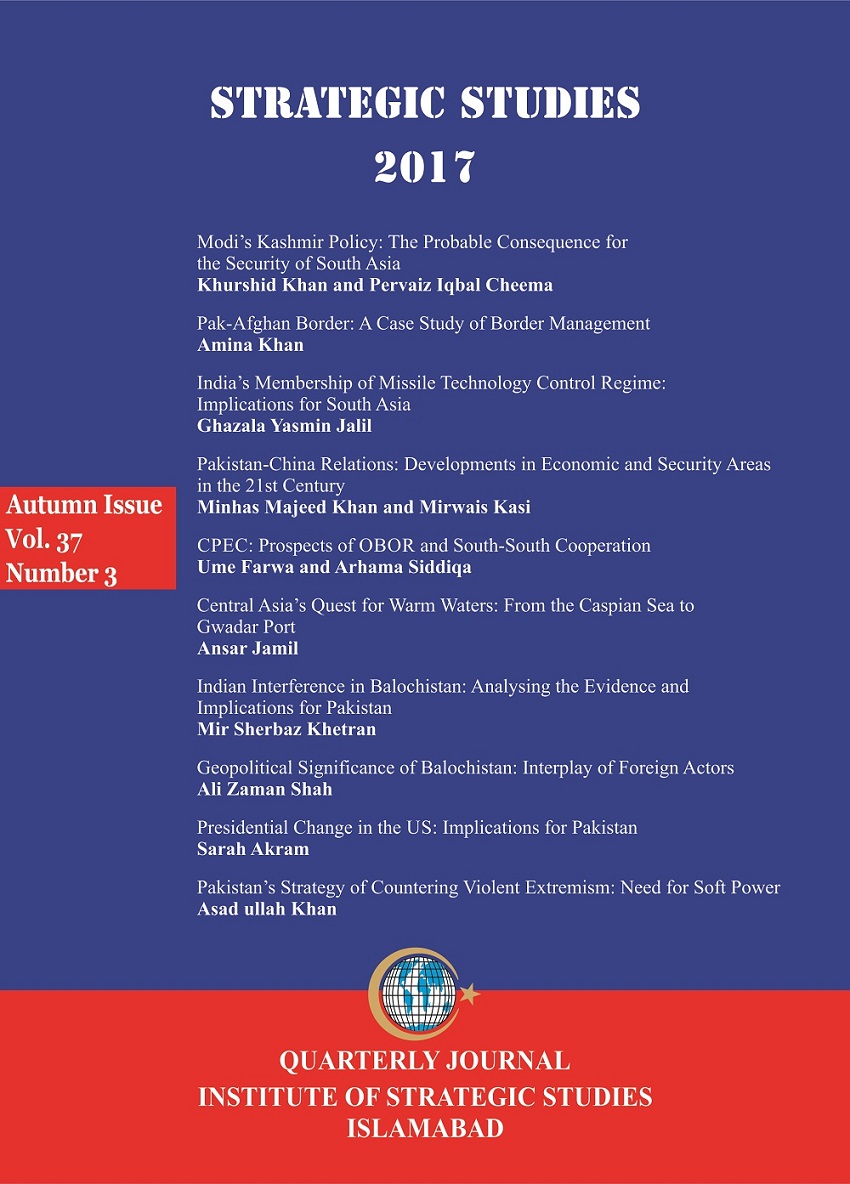
Presidential Change in the US: Implications for Pakistan
Keywords:
US, Pakistan, Pak-US Relations, Aid, Counterterrorism CooperationAbstract
The recent Republican win of Donald Trump, as the new President of the US, has raised several questions about what shape the Pak-US relations will take under the Trump administration. Analysts, policy makers and the general public have been sceptical about the new Republican nominee’s stance towards Pakistan, as has been evident from his previous statements. Also, since the US policy has not been a balanced one in recent years, owing to the situation in the region, it is pertinent to note that in recent times, the US has also been largely tilted towards Pakistan’s arch rival ─ India. Moreover, the decisive factors, likely to influence relations between the two countries, are the rise of China and the security situation in Afghanistan through which a not so pro-Pakistan, the Republican presidency will view the country and adjust its strategic interests to this part of the world. Counterterrorism operations are likely to be under constant review, as well as aid to Pakistan. The “do more” phenomenon is expected to reverberate with more enthusiasm from a Republican Congress backed by a Republican president. The most likely implication for Pakistan can be of extreme disengagement in case the Trump presidency decides to isolate the country, but a total cut off is not likely due to Pakistan’s strategic location. This paper attempts to discuss what could be the possible implications for Pakistan while keeping in view that the Trump administration has assumed power recently. The Trump administration has largely been silent on its Pakistan policy, with the exception of a few statements.
Published
How to Cite
Issue
Section
Copyright (c) 2017 Sarah Akram

This work is licensed under a Creative Commons Attribution 4.0 International License.
Copyright for articles published in Strategic Studies is retained by the authors. Authors grant Strategic Studies the right of first publication. Articles are distributed under the Creative Commons Attribution 4.0 International License (CC BY 4.0), which permits use, sharing, adaptation, distribution and reproduction in any medium or format, including commercial use, provided appropriate credit is given to the original author(s) and source, a link to the Creative Commons licence is provided, and any changes made are indicated.