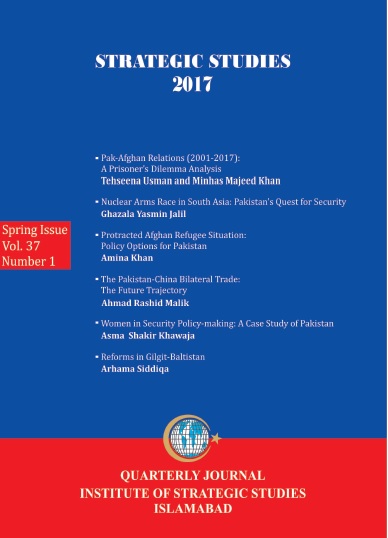
Reforms in Gilgit-Baltistan
Keywords:
Gilgit-Baltistan, Kashmir, Joint Coordination Committee on Gilgit-Baltistan, Reforms in Gilgit Baltistan, CPECAbstract
The Gilgit-Baltistan region is neither a province of Pakistan nor part of the federation. Recently, the suggestion that Gilgit-Baltistan be made a province of Pakistan has stirred a new debate, especially about Pakistan’s stance over Kashmir. Past “packages” could not be properly implemented due to the self-centred differences within the bureaucracy in Islamabad and Gilgit. Moreover, the China Pakistan Economic Corridor (CPEC) passes through this region as well. The political government in Gilgit-Baltistan and the public, at large, with the support of all political parties in this region, have repeatedly expressed their concerns about its due share in CPEC. However, the Pakistani Government is of the view that the CPEC is a game changer for Gilgit-Baltistan and Pakistan whereas the projects and 51 MoUs, enlisted by Ministry of Planning and Economic Affairs, have no mention of Gilgit-Baltistan for a single project or MoU. Added to this melee is the definite Chinese pressure to ensure that nothing impedes its progress. It is for Islamabad to come up with a reform package which will pacify the people of Gilgit-Baltistan and bring them aboard the train to economic development. This paper aims to address the pertinent question of whether Pakistan can address the issue of the constitutional status of Gilgit-Baltsiatn without compromising on its stance on Kashmir. If not, what should be done to avoid any sort of hindrance to CPEC projects being carried out in that region.
Published
How to Cite
Issue
Section
Copyright (c) 2017 Arhama Siddiqa

This work is licensed under a Creative Commons Attribution 4.0 International License.
Copyright for articles published in Strategic Studies is retained by the authors. Authors grant Strategic Studies the right of first publication. Articles are distributed under the Creative Commons Attribution 4.0 International License (CC BY 4.0), which permits use, sharing, adaptation, distribution and reproduction in any medium or format, including commercial use, provided appropriate credit is given to the original author(s) and source, a link to the Creative Commons licence is provided, and any changes made are indicated.