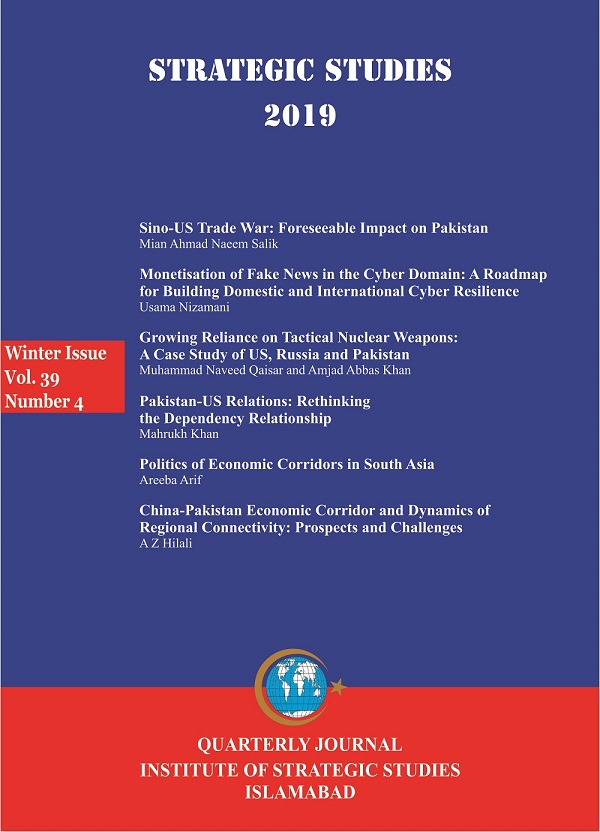
China-Pakistan Economic Corridor and Dynamics of Regional Connectivity: Prospects and Challenges
Keywords:
CPEC, China-Pakistan Relations, Gwadar Port, Indo-US Reaction, OBOR, BRIAbstract
Since 1950, China and Pakistan have enjoyed historic friendly relations. They helped each other during the times of need and have supported each other at various regional and international forums. Currently, they are engaged in building the China-Pakistan Economic Corridor (CPEC), which is a component of China’s gigantic economic venture, One Belt, One Road (OBOR). Later termed as Belt and Road Initiative (BRI), it is a framework of regional connectivity to enhance geographical linkages and to improve roads, rail networks with frequent and free exchanges of growth while moving towards more optimal business by win-win model. The CPEC, being its flagship project, has the potential to bring incredible financial gains for the BRI countries. In this connection, the South Asian countries and the global community have mixed perception about the project. However, the CPEC is important for regional countries because it will bring socio-economic prosperity and technological advancement. The CPEC will offer China and Pakistan an opportunity to promote regional connectivity, trade growth and infrastructure development. Pakistan views the corridor not only as an infrastructure and economic development programme but a key initiative for the country’s economic prosperity. Nevertheless, China needs to expand its influence in the peripheral neighbourhood, consolidate its global presence and secure future supply routes of energy and trade goods; This will help Pakistan become one of the beneficiaries of the Chinese investment in the region.
Published
How to Cite
Issue
Section
Copyright (c) 2020 A Z Hilali

This work is licensed under a Creative Commons Attribution 4.0 International License.
Copyright for articles published in Strategic Studies is retained by the authors. Authors grant Strategic Studies the right of first publication. Articles are distributed under the Creative Commons Attribution 4.0 International License (CC BY 4.0), which permits use, sharing, adaptation, distribution and reproduction in any medium or format, including commercial use, provided appropriate credit is given to the original author(s) and source, a link to the Creative Commons licence is provided, and any changes made are indicated.