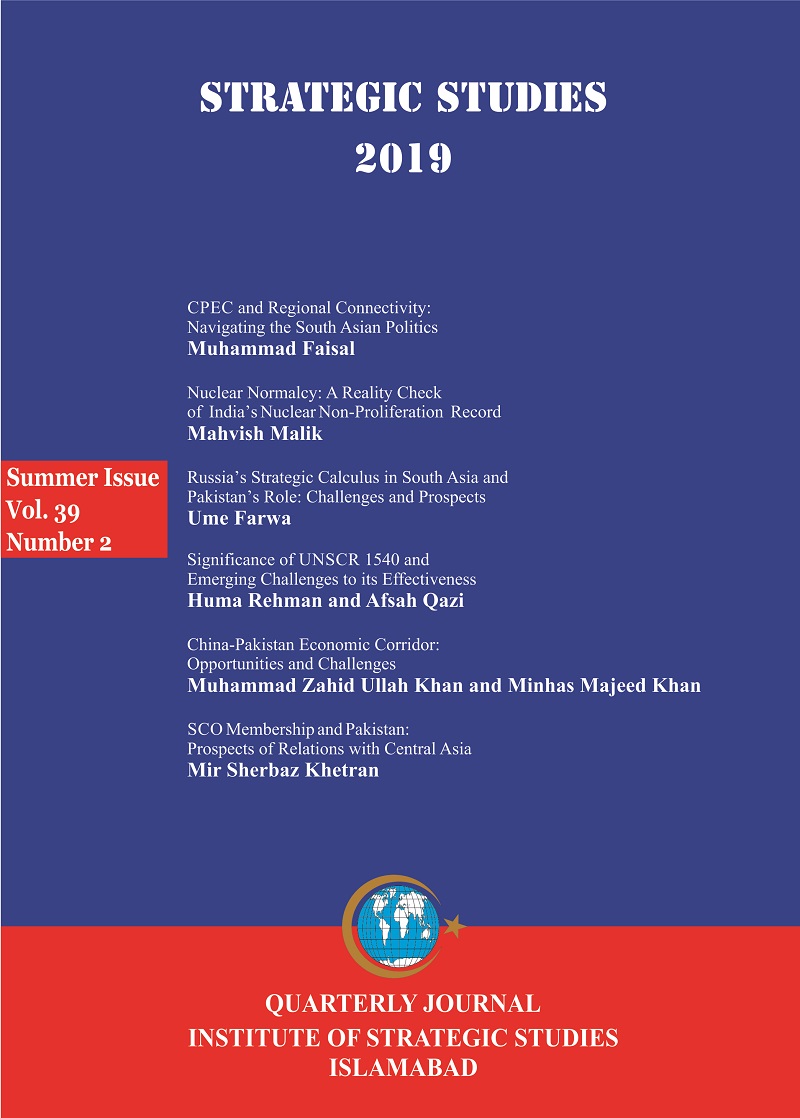
Significance of UNSCR 1540 and Emerging Challenges to its Effectiveness
Keywords:
UNSCR 1540, WMDs, Proliferation, Terrorism, Non-State Actors, Export ControlsAbstract
As the threat of Weapons of Mass Destruction (WMDs) proliferation and terrorism emerged in the early 21st century, the International non-proliferation regime began to face several challenges. Adopted in 2004, the United Nations Security Council Resolution (UNSCR) 1540 came as a response to such threats. The resolution makes it binding on all the UN members to institute effective checks against WMDs proliferation within their borders through international collaboration. The record of states’ compliance with the resolution is appreciable and it represents the success in standardising state behaviour by harmonising international and national export controls. However, a decade and a half later, the threat still exists and has not been tackled to the core, which is attributable largely to the evolving nature of the threat itself. To address this gap, this article suggests that it is imperative for the UNSCR 1540 to make necessary amendments and revisions to its mandate and mechanisms if it aims to retain its relevance.
Published
How to Cite
Issue
Section
Copyright (c) 2019 Huma Rehman and Afsah Qazi

This work is licensed under a Creative Commons Attribution 4.0 International License.
Copyright for articles published in Strategic Studies is retained by the authors. Authors grant Strategic Studies the right of first publication. Articles are distributed under the Creative Commons Attribution 4.0 International License (CC BY 4.0), which permits use, sharing, adaptation, distribution and reproduction in any medium or format, including commercial use, provided appropriate credit is given to the original author(s) and source, a link to the Creative Commons licence is provided, and any changes made are indicated.