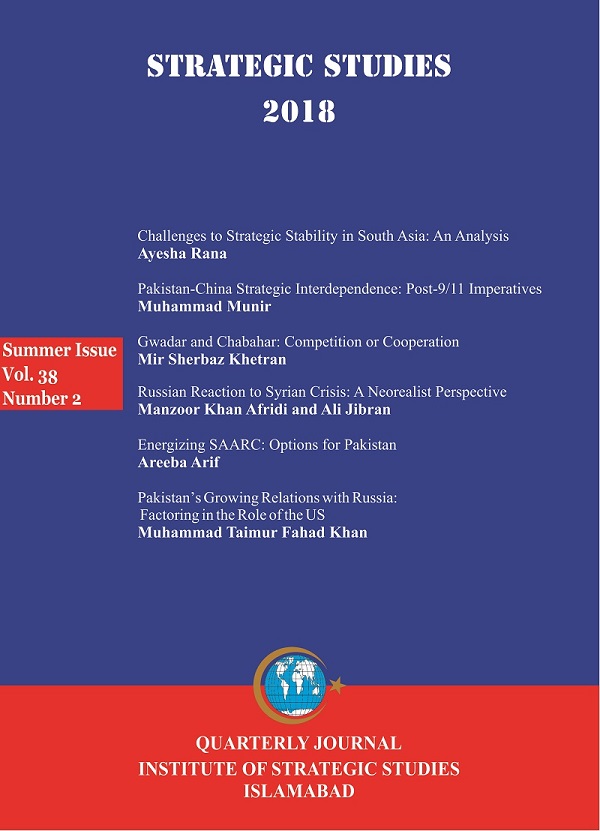
Challenges to Strategic Stability in South Asia: An Analysis
Keywords:
Stability Instability Paradox, South Asia, Pakistan, India, Nuclear Weapons, Strategic Stability ChallengesAbstract
The South Asian security environment is in a state of flux due to the rivalry of two nuclear powers, India and Pakistan. The acquisition of nuclear weapons by both the states cannot be retracted; however, it is critically important to maintain a stable and credible deterrence at the lowest possible level. Pakistan has often proposed India to develop a “strategic restraint regime” to avert the possibility of a total war that could culminate in a nuclear war. To establish such a regime, there is a need to improve bilateral relations and increase cooperation in the nuclear domain. To avoid chances of nuclear use, India and Pakistan should reduce their reliance on nuclear weapons by spending less on nuclear weapons development. This paper tries to examine the challenges to strategic stability in South Asia from domestic, regional and global perspectives and also explores that how the interplay of these challenges is undermining the South Asian strategic stability. The role of major powers, especially the US, has also been analysed for a thorough understanding of an already fragile security situation in the region.
Published
How to Cite
Issue
Section
Copyright (c) 2018 Ayesha Rana

This work is licensed under a Creative Commons Attribution 4.0 International License.
Copyright for articles published in Strategic Studies is retained by the authors. Authors grant Strategic Studies the right of first publication. Articles are distributed under the Creative Commons Attribution 4.0 International License (CC BY 4.0), which permits use, sharing, adaptation, distribution and reproduction in any medium or format, including commercial use, provided appropriate credit is given to the original author(s) and source, a link to the Creative Commons licence is provided, and any changes made are indicated.