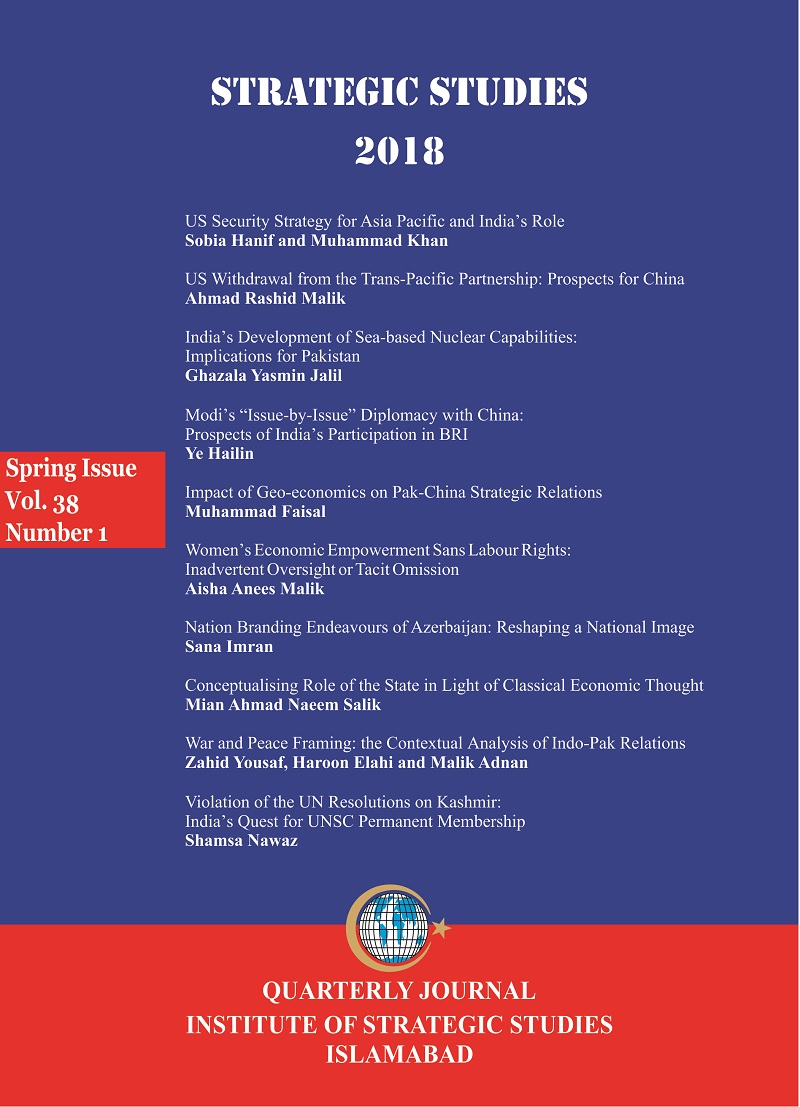
Conceptualising Role of the State in Light of Classical Economic Thought
Keywords:
Keynesian Economics, Neo-liberalism, Free Markets, Regulatory State, Economic DevelopmentAbstract
This paper attempts to analyse and describe the role played by a state in promoting economic growth by contrasting two classical schools of political economy, the Keynesian school of thought and Neo-liberalism. The British economist, John Maynard Keynes proposed optimising market practices under a technocratic system of governance. In recent decades, this influential approach has exposed its vulnerabilities to the revival of neo-liberal laissez-faire arguments. In the age of globalisation, the integration of economies around the world has put new demands on the modern state at the very same time, in many ways, which have reduced their capacities to deal with those demands. The state today is squeezed, on the one side, by the forces of global economy and, on the other side, by the political demands for devolution of power. There is an important role for the state to play in the economic development, whether it is through intervention or deregulation, the ultimate choice lies with the society regarding which of the two forms to follow. In some dramatic role reversals, the yesteryear champions of laissez-faire (the US and UK) are moving towards protectionism, whereas, the earlier advocates (China and Russia) of closed economies are today arguing the case of free and fair international trade and globalisation per se. This is no coincidence as, ironically, both the school of thoughts have a lot in common in that they complement each other in many ways in terms of intellectual ideology.
Published
How to Cite
Issue
Section
Copyright (c) 2018 Mian Ahmad Naeem Salik

This work is licensed under a Creative Commons Attribution 4.0 International License.
Copyright for articles published in Strategic Studies is retained by the authors. Authors grant Strategic Studies the right of first publication. Articles are distributed under the Creative Commons Attribution 4.0 International License (CC BY 4.0), which permits use, sharing, adaptation, distribution and reproduction in any medium or format, including commercial use, provided appropriate credit is given to the original author(s) and source, a link to the Creative Commons licence is provided, and any changes made are indicated.