
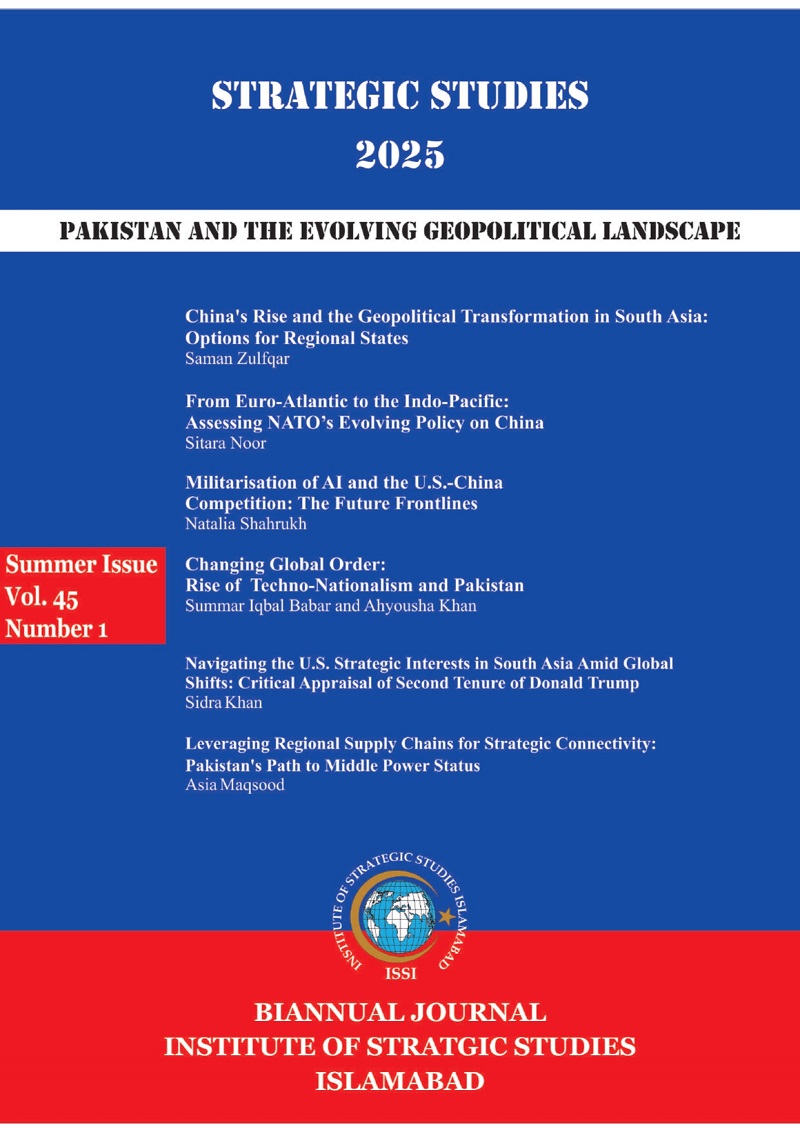
From Euro-Atlantic to the Indo-Pacific: Assessing NATO’s Evolving Policy on China
Keywords:
NATO, China, Indo-Pacific, Security, Europe, United StatesAbstract
NATO’s stance on China has gradually shifted over the years, recognising it as both a destabilising force and a systemic challenge. This change is largely driven by the intensifying competition between the United States (U.S.) and China in the Indo-Pacific region. However, the differing rates at which the U.S. and European members of NATO have adjusted their positions reflect more about their evolving perspectives than any significant change in China’s actions. While NATO’s focus will likely remain Euro-centric, European members are increasingly pressured to address the implications of Chinese actions due to perceived links between Euro-Atlantic and Indo-Pacific security (especially after No-limits friendship between Russia and China). This paper sheds light on the factors that have contributed to making China a systemic rival of NATO. It also seeks to identify the internal and external challenges that have hampered the development of a unified NATO strategy on China. The paper highlights that in order to manage these complexities, NATO may need to enhance its political role and invest in risk reduction measures to prevent inadvertent escalation in case of a conflict.
Published
How to Cite
Issue
Section
Copyright (c) 2025 Sitara Noor

This work is licensed under a Creative Commons Attribution 4.0 International License.
Copyright for articles published in Strategic Studies is retained by the authors. Authors grant Strategic Studies the right of first publication. Articles are distributed under the Creative Commons Attribution 4.0 International License (CC BY 4.0), which permits use, sharing, adaptation, distribution and reproduction in any medium or format, including commercial use, provided appropriate credit is given to the original author(s) and source, a link to the Creative Commons licence is provided, and any changes made are indicated.