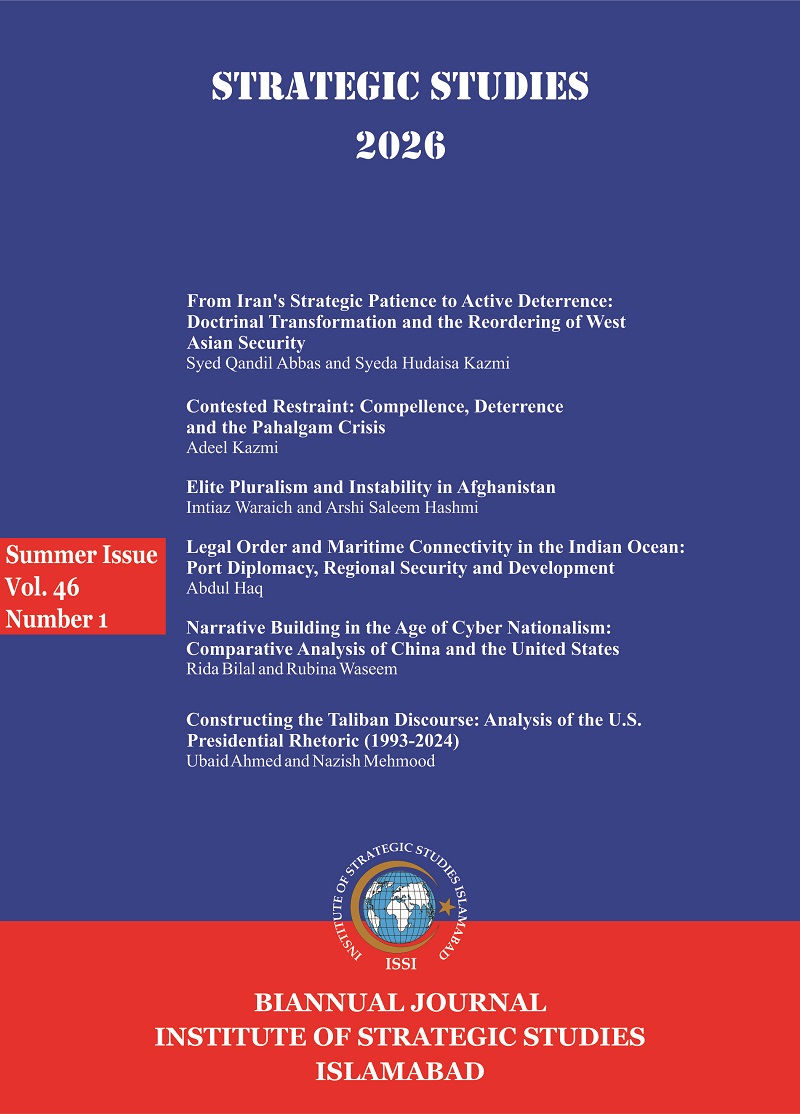
Elite Pluralism and Instability in Afghanistan
Keywords:
Afghanistan, Afghan Elite, Constructivism, Anarchy, Elite Instrumentalism, Protracted ConflictAbstract
Afghanistan’s political landscape is defined by a multiethnic and competitive elite structure. Rival factions comprising tribal leaders, warlords, and political figures exploit ethnic identity and state institutions not for nation-building but to consolidate their own power and undermine adversaries. This paper analyses how elite pluralism and instrumentalism have contributed to Afghanistan’s persistent instability, and why successive regimes have failed to establish a cohesive and inclusive state. Drawing on elite theory, instrumentalism, and constructivism as its theoretical framework, the research qualitatively examines the prevalence of instrumentalism across different regimes, from the post-2001 Republic to the re-establishment of the Taliban emirate in Afghanistan. It examines how elites in the Karzai and Ghani administrations utilised patronage networks and ethnic mobilisation to hinder the development of a unified national identity, thereby rendering the state ineffective and vulnerable to corruption. It further finds that the Pashtun-dominated Taliban elite employs a different but equally exclusionary form of instrumentalism, utilising a singular religious narrative to suppress pluralism and centralise authority. The study finds that Afghanistan’s anarchy is not merely a failure of state-building, but a condition reproduced by elite competition, generating protracted social conflict. To achieve positive peace, incentives for elite must change away from divisive instrumentalism to inclusive political settlement under inclusive doctrine.
Published
How to Cite
Issue
Section
Copyright (c) 2026 Imtiaz Waraich

This work is licensed under a Creative Commons Attribution 4.0 International License.
Copyright for articles published in Strategic Studies is retained by the authors. Authors grant Strategic Studies the right of first publication. Articles are distributed under the Creative Commons Attribution 4.0 International License (CC BY 4.0), which permits use, sharing, adaptation, distribution and reproduction in any medium or format, including commercial use, provided appropriate credit is given to the original author(s) and source, a link to the Creative Commons licence is provided, and any changes made are indicated.