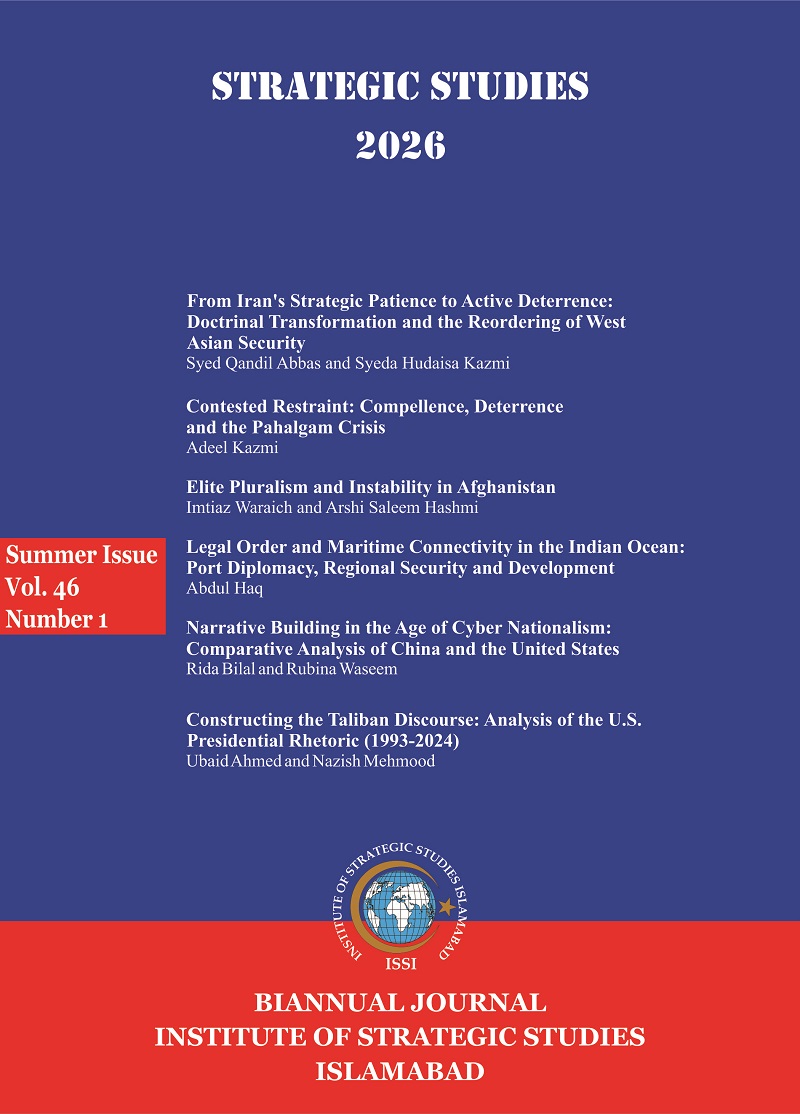
Constructing the Taliban Discourse: Analysis of the U.S. Presidential Rhetoric (1993-2024)
Keywords:
Critical Discourse Analysis (CDA), Afghanistan, Taliban, Global War on Terror (GWOT), Discursive Practices, Securitisation, Language & PowerAbstract
This paper analyses the progression of the U.S. presidential discourse regarding the Taliban from 1993 to 2024. It explores how the discursive formation of identity and the rhetorical framing of the Afghan Taliban constitute foreign policy, provide legitimacy and thus shape negotiating dynamics. Drawing on Teun A. van Dijk’s socio-cognitive approach and Norman Fairclough’s three-dimensional model (textual analysis, discursive practices, and social practices), this work is a critical discourse analysis (CDA). It investigates how successive administrations — Clinton, Bush, Obama, Trump, and Biden — have been developing narratives that redefined the Taliban from mere ‘terrorists’ to ‘negotiating partners’ in the peace process. The findings demonstrate that changes in discourse are indicative of both domestic changes within successive U.S. administrations and broader geopolitical shifts. Bush’s moral supremacy and declaration of ‘war on terror,’ Obama’s pragmatism rooted in human rights, Trump’s transactional rhetoric marked by implicit legitimisation, and Biden’s recalibration centred on the withdrawal of U.S. forces from Afghanistan have been studied and examined in this study. Ultimately, the research underscores that U.S. engagement with the Taliban exemplifies the complex dynamics of U.S. regional aspirations, the role of the Afghan Taliban in future governance assurances regarding the denial of safe havens for terrorist groups, and future counter-terrorism strategies.
Published
How to Cite
Issue
Section
Copyright (c) 2026 Ubaid Ahmed, Dr. Nazish Mahmood

This work is licensed under a Creative Commons Attribution 4.0 International License.
Copyright for articles published in Strategic Studies is retained by the authors. Authors grant Strategic Studies the right of first publication. Articles are distributed under the Creative Commons Attribution 4.0 International License (CC BY 4.0), which permits use, sharing, adaptation, distribution and reproduction in any medium or format, including commercial use, provided appropriate credit is given to the original author(s) and source, a link to the Creative Commons licence is provided, and any changes made are indicated.