
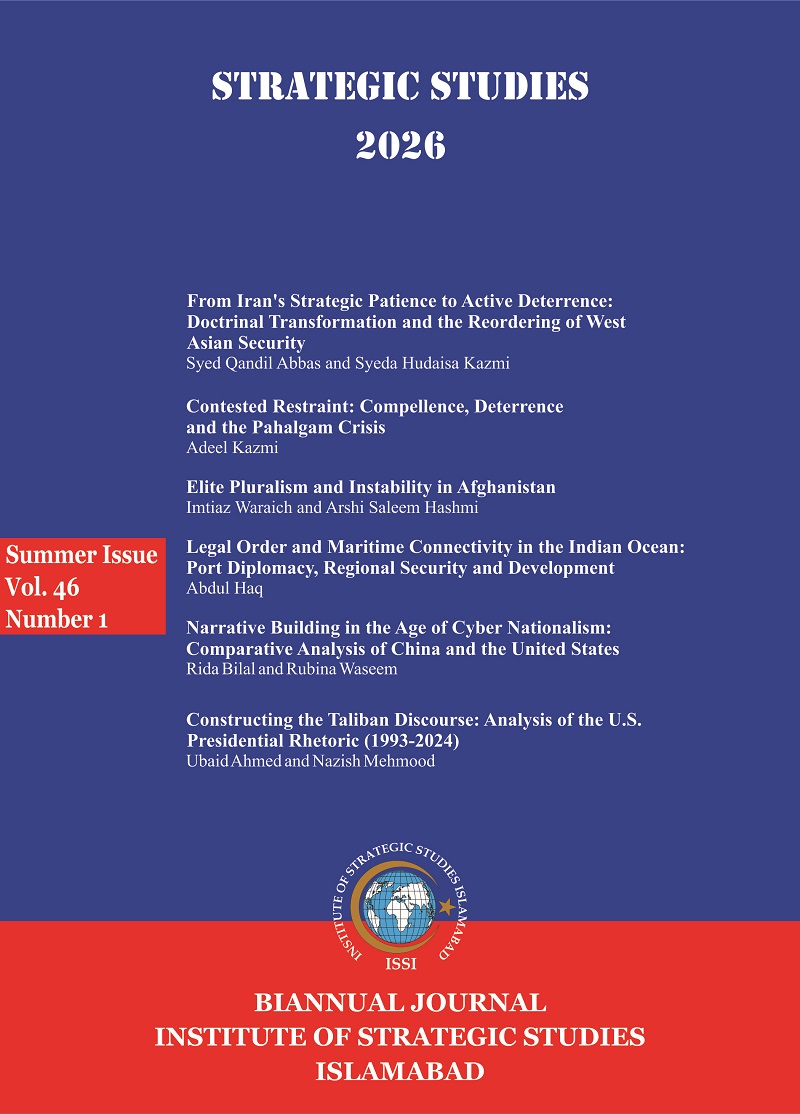
Narrative Building in the Age of Cyber Nationalism: Comparative Analysis of China and the United States
Keywords:
Cyber Nationalism, Digital Identity, Narrative Theory, The United States (U.S.), China, Social Media, Network SocietyAbstract
This paper tends to explore how national identity is contested in two global powers, China and the United State (U.S.) through the lens of cyber nationalism. Based on Walter Fisher’s narrative paradigm theory and Manuel Castells, Network Society Theory, this research analyses the way ideological narratives are contested through digital platforms where government and citizens engage in powerful acts of storytelling. Despite the differences, both states rely on the digital space to support national identity and political legitimacy in a manner that is rooted in culture and emotionally appealing. The findings of this research reveals that cyber nationalism is not a mono-dimensional phenomenon, it is formed by both the top and bottom, the actions of the state and that of individuals. This research provides a nuanced perspective on the narratives that impact our digital age as masses increasingly turn to the internet to make sense of their belongings.
Published
How to Cite
Issue
Section
Copyright (c) 2026 Rida Bilal, Dr Rubina

This work is licensed under a Creative Commons Attribution 4.0 International License.
Copyright for articles published in Strategic Studies is retained by the authors. Authors grant Strategic Studies the right of first publication. Articles are distributed under the Creative Commons Attribution 4.0 International License (CC BY 4.0), which permits use, sharing, adaptation, distribution and reproduction in any medium or format, including commercial use, provided appropriate credit is given to the original author(s) and source, a link to the Creative Commons licence is provided, and any changes made are indicated.