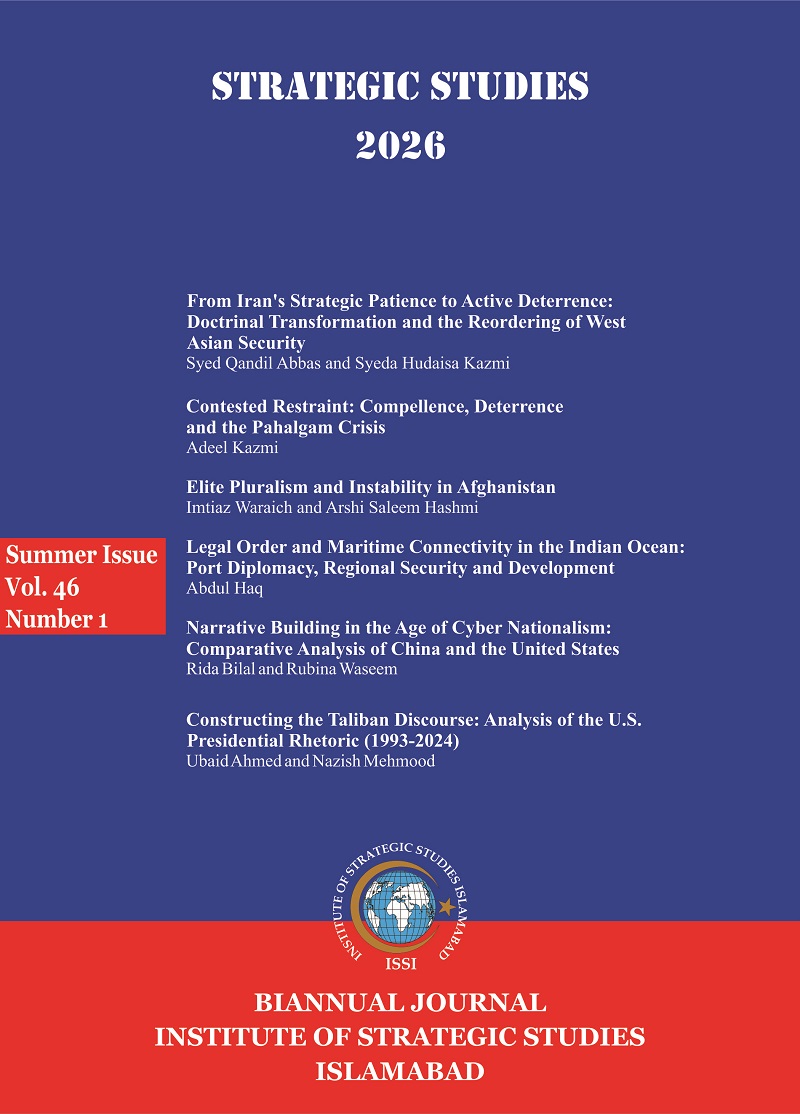
From Iran’s Strategic Patience to Active Deterrence: Doctrinal Transformation and the Reordering of West Asian Security
Keywords:
2026 Iran War, the United States, Israel, Iran, Strategic Patience, Deterrence, Persian Gulf, West-Asian Security OrderAbstract
The 2026 Iran war has immensely impacted the West Asian security order. Differences between the United States (U.S.) and Israel with Iran are more than four decades old, but these differences have never led to a limited or full-scale war. Despite huge pressure from the U.S. and Israel, Iran adopted the doctrine of strategic patience, while the U.S. also preferred immense economic sanctions on Iran instead of direct military confrontation. This paper is an attempt to analyse how and why Iran shifted its policy from strategic patience to active deterrence, as well as how this doctrinal transformation of Iran played a significant role in the reordering of the West Asian security. To address these questions, the theoretical combination and integration of offensive realism and deterrence is employed, which maintains that Iran’s shift from strategic patience to active deterrence is not a tactical adjustment but rather represents a structural transformation.
Published
How to Cite
Issue
Section
Copyright (c) 2026 Syed Qandil Abbas, Syeda Hudaisa Kazmi

This work is licensed under a Creative Commons Attribution 4.0 International License.
Copyright for articles published in Strategic Studies is retained by the authors. Authors grant Strategic Studies the right of first publication. Articles are distributed under the Creative Commons Attribution 4.0 International License (CC BY 4.0), which permits use, sharing, adaptation, distribution and reproduction in any medium or format, including commercial use, provided appropriate credit is given to the original author(s) and source, a link to the Creative Commons licence is provided, and any changes made are indicated.