
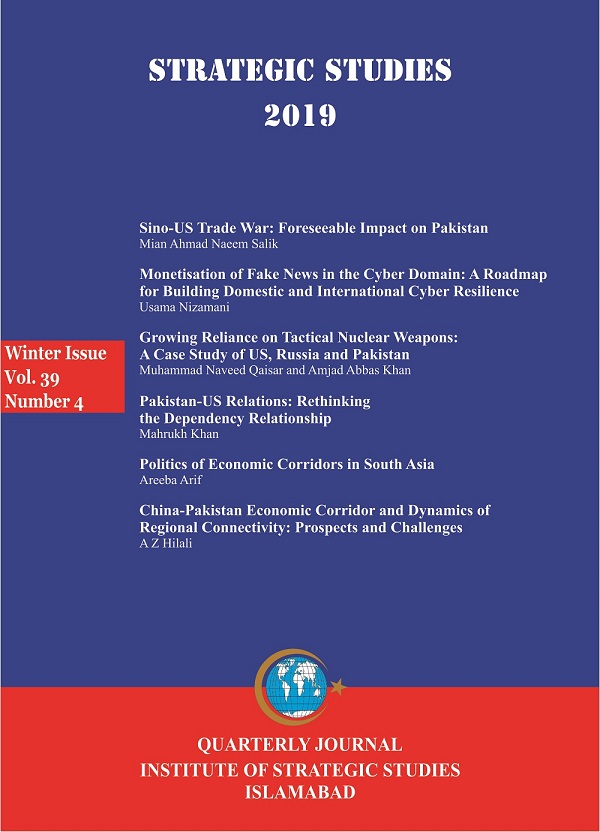
Monetisation of Fake News in the Cyber Domain: A Roadmap for Building Domestic and International Cyber Resilience
Keywords:
Fake News, Programmatic Advertising, Advertisement-Dollars, Internet Intermediaries, Media Literacy, Online Revenue Generation ModelAbstract
The online domain has witnessed the proliferation of fake news in the past few years all over the world. This overwhelming amount of (dis)information has created incentives for the proliferators of fake news to benefit from ongoing political developments across the world, due to the courtesy of the existing model of online revenue generation on the Internet. The unregulated, liberal and open nature of the Internet has created an unintended consequence of incentive maximisation for fake news. This paper takes an analytical look at the relationship between revenue generation model in the cyber-domain and how content producers of fake news benefit from it. This paper postulates that the existing online advertisement model remains lucrative for fake news publishers particularly in regions such as South Asia. Its interplay with social media platforms enables further monetisation and spreading of fake news to Internet users. It analyses the relationship between these factors and suggests cross-sector solutions for de-incentivising and countering fake news in the cyber domain.
Published
How to Cite
Issue
Section
Copyright (c) 2020 Usama Nizamani

This work is licensed under a Creative Commons Attribution 4.0 International License.
Copyright for articles published in Strategic Studies is retained by the authors. Authors grant Strategic Studies the right of first publication. Articles are distributed under the Creative Commons Attribution 4.0 International License (CC BY 4.0), which permits use, sharing, adaptation, distribution and reproduction in any medium or format, including commercial use, provided appropriate credit is given to the original author(s) and source, a link to the Creative Commons licence is provided, and any changes made are indicated.